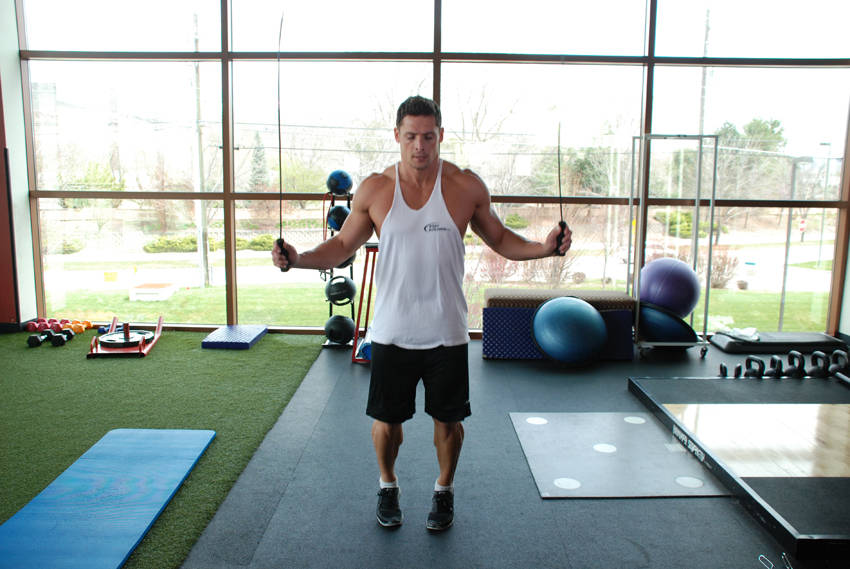
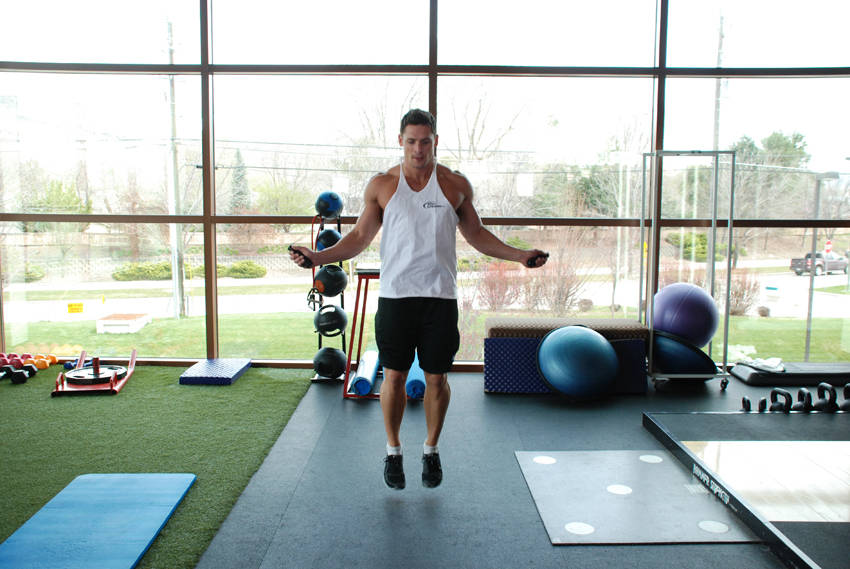
How to do the Rope Jumping
- Hold an end of the rope in each hand. Position the rope behind you on the ground. Raise your arms up and turn the rope over your head bringing it down in front of you. When it reaches the ground, jump over it. Find a good turning pace that can be maintained. Different speeds and techniques can be used to introduce variation.
- Rope jumping is exciting, challenges your coordination, and requires a lot of energy. A 150 lb person will burn about 350 calories jumping rope for 30 minutes, compared to over 450 calories running.
Muscles worked
| Role | Muscles |
|---|---|
| Primary | quads |
| Secondary | calves, hamstrings |
| Equipment | other equipment |
| Difficulty | intermediate |
No other equipment? Train the same muscles with these
Ordered by how likely you are to own the 6 options.
Easier than the Rope Jumping
Same movement pattern, lower entry difficulty — work up from here.
Harder than the Rope Jumping
Common questions
What muscles does the Rope Jumping work?
The Rope Jumping primarily works the quads, with the calves and hamstrings as secondary movers. Bicycling, Bicycling, Stationary, and Elliptical Trainer train the same muscle, across 9 equipment types.
What equipment do you need for the Rope Jumping?
The Right Equipment. Without the right equipment, Trail Running/Walking, Alternate Leg Diagonal Bound, and Bench Jump train the same muscle, and 27 of the catalogue's options for this muscle need no equipment.
Is the Rope Jumping suitable for beginners?
It is rated intermediate. Start with Bicycling, Bicycling, Stationary, and Recumbent Bike and work up.
Similar exercises
Build a full legs session around this
The free generator picks the sets, reps and supporting exercises for you — using only the equipment you actually have.
Build a free workout